

Maintenance of public passenger vehicles
On this page
Requirement to develop and implement a documented maintenance program
As an accredited operator, you must develop and implement a documented maintenance program for each vehicle you use to provide a public passenger service. This program ensures vehicles are safe, reliable, and meet regulatory standards.
Your maintenance program must include records of:
- daily pre-trip vehicle inspections
- reporting and clearing vehicle defects
- the maintenance schedule for each vehicle.
Daily pre-trip inspections
Daily pre-trip inspections are essential to identify defects that may:
- endanger public safety
- reduce passenger comfort.
The daily pre-trip inspection must be conducted by the driver, operator or a person authorised by the operator. It should cover the following items (but is not limited to):
- Fluid levels: Engine oil, fuel, coolant and brake fluid.
- Brakes: Operation and effectiveness.
- Steering: Effectiveness.
- Horn: Sound warning device.
- Mirrors: Stability and operation of rear vision mirrors.
- Tyres and wheels: Condition and pressure.
- Lights and signs: Functionality and visibility.
- Windscreen: Cleanliness and defects.
- Vehicle interior: General condition, including seatbelt wear.
- External doors: Fastening of luggage compartments, engine bay compartment, and other external doors.
Recording inspections
You must maintain a record of daily inspections. This can be handwritten or electronic. View an example of an acceptable method for recording daily inspections.
Defect reporting and clearing defects
Key requirements:
- Defect reporting:
- Drivers must report defects to the operator.
- All defects must be recorded in a written or electronic format.
- Defect assessment:
- Assess whether the vehicle is safe to drive.
- Record details of the defect and actions taken.
- Defect repairs:
- Vehicles with safety-critical defects must not return to service until repaired.
- Defects affecting passenger comfort must be fixed within a reasonable time.
- Record keeping:
- Maintain records of defect reports, repairs, and clearance dates.
- Records must be kept in a format that is auditable by the Department of Transport and Main Roads (the department).
View an example of an acceptable method for Defect reporting and clearing defects.
Maintenance schedule
You must keep a maintenance schedule that records all servicing and maintenance for each vehicle. You must provide these records at the request of the department.
Requirements for the maintenance schedule
- The schedule must meet or exceed the servicing and maintenance program specified by the vehicle's manufacturer.
- It must consider environmental factors, such as harsh road conditions, which may require more frequent servicing.
Example maintenance schedule
Vehicle manufacturers make maintenance schedules available and often provide a recommended program with new vehicles.
| Frequency | Vehicle service type |
|---|---|
| Every 5,000 km | A Service |
| Every 20,000 km | B Service |
| Every 80,000 km | C Service |
Your schedule should list the work to be undertaken at each service. Records must include any completed planned servicing.
If the vehicle has travelled beyond the manufacturer’s recommended maintenance schedule (e.g., 150,000 km or 200,000 km), you must document in your maintenance schedule that you will duplicate the servicing requirements for the next period.
For more detail about record keeping requirements refer to Record keeping and audit requirements on the Operator accreditation responsibilities webpage.
Examples of a vehicle inspection, defect reporting and fixing system
Example 1: Record of daily inspection
Example 1 below shows how an operator might address records to be kept about the use of each vehicle and fatigue management records while also addressing pre-trip inspects and the defect reporting and clearing records.
On 11 March 2024, the driver notes a chip in the windscreen during a pre-trip inspection. The defect is recorded in the workshop fault record system, and a repair is requested. Since the chip does not pose a safety risk the vehicle remained in service until the repair is completed on 12 March 2024.
If the defect poses an immediate safety risk (for example, faulty brake lights), the vehicle must not be used until the defect is repaired.
Example 1. Record of daily inspection and additional checks required by operator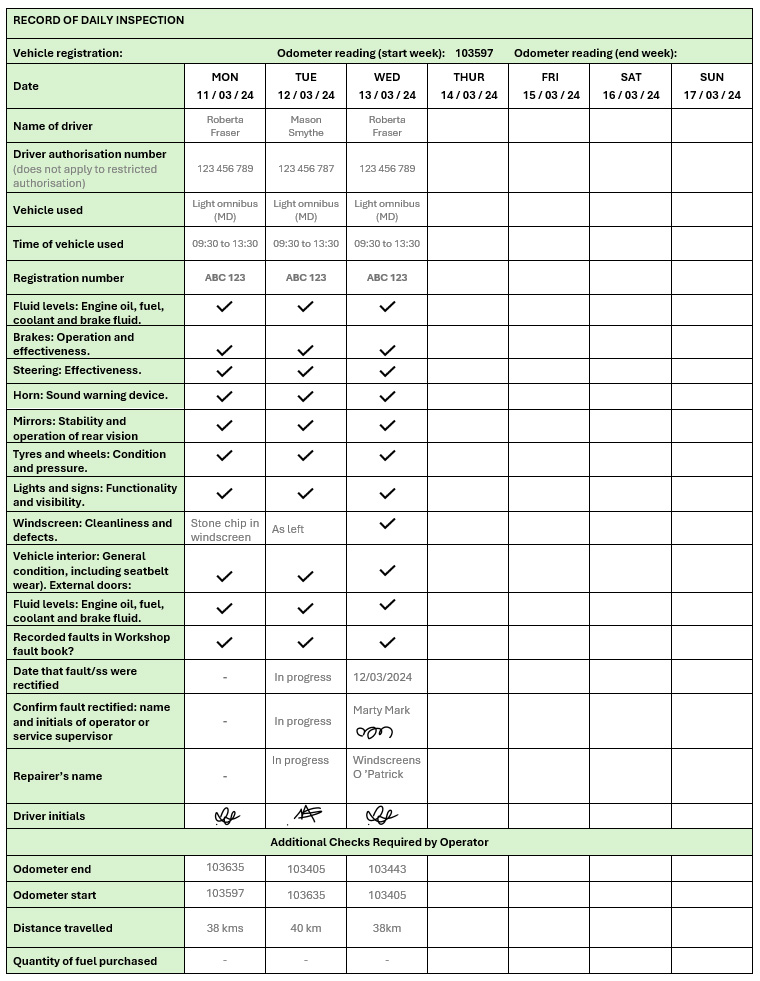
Example 2: Workshop fault/default record example
Simple handwritten or electronic records can be used for recording the requirements for vehicle repairs and services.
All faults must be recorded, regardless of how the fault is identified. This includes daily inspections and faults identified during the Certificate of Inspection (COI) process – for example, a faulty taillight is identified at a pit inspection.
In the example below, the defect details and defect clearing details are recorded so that operators, drivers or departmental officers can see when and how faults were identified and reported, as well as which faults remain and when the faults have been corrected. You must record the action taken to repair faults and when it was cleared by the service supervisor.
Example of a fault spreadsheet where the windshield damage reported for the date 15 March 2024 has not been cleared by the operator/ service supervisor until the 23 March 2024. An example of a COI defect being cleared is also shown.
Example 2: Workshop fault/default record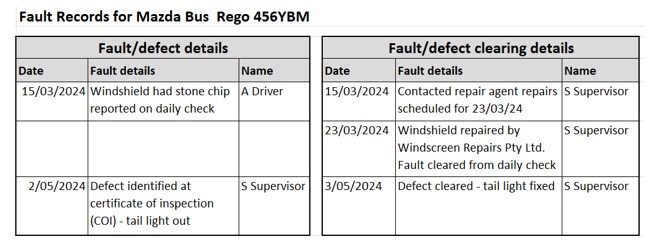
References
Transport Operations (Passenger Transport) Regulation 2018
- Section 18I: Requirements for documented maintenance programs.
- Section 276: Records to be maintained.
- Schedule 1AA, Part 5: Maintenance records for buses.
Read the full PT Regulation on the Queensland Legislation website.
National Heavy Vehicle Regulator (NHVR):
- Provides guidance on maintenance standards for heavy vehicles, including buses used in passenger transport.
Visit the NHVR website.
Transport Operations (Road Use Management—Vehicle Standards and Safety) Regulation 2021:
- Section 71: Requirements for certificates of inspection for passenger transport vehicles.
- Ensures vehicles meet safety standards before being used for passenger transport services.
Read the full TORUM-VSS Regulation on the Queensland Legislation website.
- Last updated
- 20 February 2026