

Guidelines for safely transporting people with disability
On this page
Bus drivers of urban services should use the following guidelines when transporting people with disability and reduced mobility.
Urban bus services are generally those that are available to the general public and operate on a scheduled timetable, excluding community transport bus services, and long-distance coach services.
Accessible public transport
Around one in five Australians have some form of disability and one in 10 have an invisible/hidden disability. Invisible/hidden disability is not outwardly apparent. Examples include learning challenges and mobility, speech, visual or hearing impairment, as well as chronic illnesses and mental health conditions.
Availability of accessible public transport is critical for all members of the community. Accessible public transport provides an important pathway for people to participate fully in community life. People rely on these services to take them to work or study, connect them to family, friends and the community, or help them access services such as healthcare.
We want public transport to be accessible to everyone and ensure barriers to access are removed. This is particularly important for some of our more vulnerable members of the community, such as older people and people with disability.
We aim to increase awareness about the needs of people with disability to make it safer and easier for them to use the public transport network.
Your role and responsibilities
As a bus driver, and in line with relevant transport legislation, you are responsible for the safety of your customers. Your good driving, in addition to safety, care and courtesy are vital because you are the face of the public transport experience.
When driving a public passenger vehicle, you must:
- be courteous to customers and the public
- give help if a customer asks for help to board or leave a vehicle (you are not required to lift or carry a mobility aid or assist with customer's personal needs)
- allow a person to take an approved assistance animal on a vehicle.
Hailing
Some customers may not know they need to hail the bus or they might have a vision impairment, making it difficult for them to know which bus to hail. Bus hailing kits may be used to display the bus route number to you. Look for customers using these kits or similar devices.
Customers with disability, mobility impairment, or who are older may have difficulty trying to locate where they should wait for their desired bus service. Look for these customers when arriving at your bus stop and ask them if they are waiting for your bus – particularly if:
- you see a customer with a long white cane or an assistance animal
- at busy busway stops, such as the Cultural Centre Busway Station.
Be sure you travel through to the lead stop checking if there are customers waiting for your service. You may receive instruction from Bus Control if a passenger requires boarding assistance from the platform.
Boarding and disembarking

You must give customers reasonable assistance to safely board or leave a vehicle, such as:
- stopping as close to the kerb as possible
- placing a ramp at the front door of the bus to meet the ground – not all disability is visible, and people with reduced mobility also benefit from using the ramp
- kneeling a low floor bus to the height of the kerb to make boarding or leaving the bus safer and easier
- waiting until customers are seated or customers using a mobility device in an allocated space have applied the brakes before driving away.
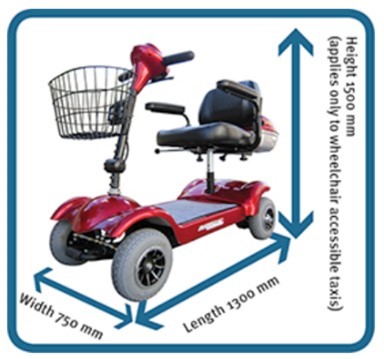
You do have the right to refuse access if you think a mobility device does not meet the specifications in the Transport Standards, including:
- size (see image below)
- weight – (a boarding device such as bus ramp must be able to support a total weight of up to 300kg).
Allocated spaces
Give people using mobility aids such as wheelchairs, mobility scooters, walkers, braces and artificial limbs including canes and crutches priority to use allocated spaces. If the allocated space is occupied, ask customers to clear the space. If the space is occupied by a pram, ask for the pram to be folded up and stored in the luggage compartment and have the customer and child move to another seat.
You should be aware of your operator's policy about the direction of travel for customers using mobility devices. Transport operators may determine the direction that customers are oriented in buses, which may support containing the movement of mobility devices. However, many people prefer facing forward.
You may also encourage a customer using a mobility scooter to relocate to a fixed seat if possible as this may provide a more stable and potentially safer journey. In this case, you should wait until the customer has relocated before driving.
Priority seats
People with an invisible or hidden disability may not feel comfortable seeking assistance, particularly in accessing priority seating areas.
If a customer indicates that they would benefit from using a priority seat which is occupied, you could ask for the seat to be vacated.
Look for customers wearing a device, such as a badge or lanyard, indicating they have an invisible or hidden disability and they require a priority seat.
Drive safely and consider the comfort of your customers
Be aware that the forces of acceleration, turning and braking can be strong and can impact the stability of mobility devices. Remember to:
- drive within the speed limits
- drive to conditions.
If you’re driving an electric bus, look for people with disability wanting to board your service. Electric buses are quiet and customers may not hear the bus approaching.

- Last updated
- 19 July 2025